Stepping Into The Blue Hour with Amaya Laucirica
The Blue Hour refers to the liminal time between day and night. What drew you to this idea, and how does it reflect the music on the album?
During the pre-production of the album, I collaborated with singer-songwriter Laura Jean, and she conceived the idea of the songs having a conceptual tone profile that reflected various stages of the day. She believed that some songs were pre-dawn dark, then the first rays of the sun burst over the horizon. I really liked the concept of the songs having a relationship to the time of day. At first, I was drawn to the light phase of the day, known as the Golden Hour, because it is the most magical and transformative, where you feel an infinite sense of possibility. Then I came across the time of day known as The Blue Hour, which is the moment just after sunset and before dusk, marking the transition between day and night. And that’s the space where I felt the mood of the lot of the songs occupying—that time for reflection and to appreciate the beauty that is happening.
You began writing these songs in 2018, across some massive personal changes in your life — motherhood, periods of disconnection. How do you hear that journey in the record now?
A lot of the songs were written during times of transition. Before deciding to become a mother, I was also thinking of moving back overseas again. There were questions about where I wanted to be and what I wanted to be doing. And ultimately becoming a mother, initially, you’re in the same spot for a long time with a human being dependent on you 24 hours a day. This is quite the opposite of being an independent traveller. So, you sacrifice a great deal of that independence, but you also gain a great deal of love for your baby and insight about yourself because you are now raising a little person. And when I was writing the album, it was like therapy sessions for me. I had no other outlet to express ideas; life was very internal, having a baby during a pandemic and a lockdown. So I poured every spare minute I had when the baby was asleep or out of the house with my partner, writing songs. When I listen to the album now, I feel like that time was so long ago, but I also hear a celebration of that time. I was finding my voice as both an artist and as a mother, and I was embracing the change.
You started recording with your band, but ultimately, The Blue Hour became a largely solo project. What shifted for you creatively during that process?
It was the songs themselves that paved the way for this album to have a different approach. A lot of the songs were written in a solo context, on a piano. When we tried to record those songs with the band, it just didn’t work. They needed to have minimal touch. And some songs stylistically didn’t suit the band I was playing with at the time. I realised this wasn’t going to be a rock album, it was heading towards being a pop album, experimenting with different styles and crossing genres. And it took a lot of stopping and starting, trying things out to realise where this album needed to go. And I realised at one point I should just work on this album with one collaborator, and I ended up recording the album with James Cecil at Super Melody World and on the album it’s pretty much just him and me playing all the instruments apart from getting live drums recorded on a few tracks and a few additional players here and there.
Were there particular artists, composers, or works outside of music that inspired this record?
That’s a good question. I’m often inspired by books and films when writing music. I was especially inspired after seeing the documentary on David Bowie's‘ Moonage Daydream’. Especially his takes on creativity and pushing yourself as an artist to work outside your safe zone and dig a little further afield to find those moments of gold.
How did working with James Cecil (Architecture in Helsinki) as producer shape the final sound?
This project was a big one, and I knew I couldn’t do it all on my own. I’m so grateful that I found James and that he agreed to do it. There were so many ways these songs could have gone; I felt like I was initially in a rabbit warren, unsure of which direction to take. I was too close to the songs in that respect and needed somebody with an outsider ear and vision to help direct. The beautiful thing about collaboration is that you are making art with somebody who may have different ideas to you, and can hear and see things that you can’t. And sometimes those risks are worth taking, because you might initially feel a little out of your depth, but then sometimes the song is going to a better place. It’s going where it needs to go. And there’s a lot of letting go, but also in turn, you’re becoming a better artist and collaborator. You’re working as a team. I trusted James from the outset. I liked most of his ideas and felt confident he was going to steer the project in the right direction to get it over the finish line. And he did. All the songs had their own style, and my initial concern was how they would all come together to form a cohesive album. But James could hear from the get go how it was all going to work. We discussed references for each song extensively at the start; everything was mapped out before we began recording each one.
Many of the songs feel cinematic, almost like they belong to imagined films. Do you think of your songwriting visually?
Sometimes my songs feature characters who are inspired from films or stories. So at times I feel like I’m creating a world for that character to live in when I’m writing which I guess you could say draws parallels to film. Before we recorded the final version, I sat down and wrote the mood and character descriptions for each song. I feel the album is very feminine, and there are different type and characters across the album who are part me and part creation and display various aspects of my personality.
Your track When I’m With You has echoes of Ryuichi Sakamoto and David Sylvian — what role does atmosphere and mood play in your writing?
More often than not, mood and atmosphere is the biggest influence when I sit down to write a song. Sometimes when I sit down to write a song I won’t know what I’m writing about until I’m midway through the song. I’ve sat down to express something, a feeling which then turns into a melody idea which was inspired by a mood or feeling.
With When I’m With You I was inspired by watching the film Ryuichi Sakamoto: Coda. I just love the space in his music and where it takes you. So I came up with the piano line first and then a melody but words took a long time to come to me as I didn’t really know what the song was about initially. It was a mood, but I knew it needed a character to tell the story. So then I created a character for it, because I could feel the song was sad but also searching for something. And the character in the song is in a doomed relationship and can’t find her way out. She’s trapped, and the whole time is trying to think of how she can get away but she doesn’t.
How did motherhood influence the way you approached writing and recording — not just thematically, but practically?
I know many people who have put their art on hold when they’ve become parents. Because they feel there is no time to do it anymore. And yes, time is my biggest obstacle, being a working mum. So, trying to find the time to create, and then make the record (and now releasing it) are the most significant factors I face.
But when my daughter was little, I felt the urge more than ever to write and communicate. It’s a space where I can express my ideas and feelings that I’m not able to do in any other way. And I love it and I don’t want to give it up just yet. I feel like it’s always there for me, whenever I want to tap into it and it’s a part of me. And I want to show my daughter that you should pursue the things you love, no matter how hard those things may be to do.
When my daughter arrived, finding a space to work was crucial. I’m very fortunate now to have a studio space. I know a lot of artists don’t, so it’s not something that I take for granted. But having the space has helped so much. My husband is also in a similar position to me having a job, being a parent and artist. And we practically time share our studio to be able to do our work. So it takes a great deal of being organised but we manage and make it work.
There’s a thread of humour in the way you talk about darker songs. How do you balance light and shade in your work?
You need both, I feel, to stay sane. You can’t always be happy and you can’t always be sad. You need the balance, and I find that people who have a good sense of humour about things can endure hardships easier. And this is a hard job, and it throws so many challenges. And there is a lot going on in the world that is really dark. I try to be optimistic about a lot of things, which is my nature, but I would be lying to say that is not being challenged everyday. And when I write songs, most often than not it is therapeutic for me. So if I’m writing an uplifting song, its because I’m craving some lightness. And when I write a dark song, it’s when I surrender to those feelings and want to explore them.
You’ve always worked at the edges of pop, shoegaze, and experimental music. How do you see The Blue Hour sitting in today’s musical landscape?
I feel even though it’s my most poppiest and immediate album, it’s also still classic songwriting. Even though I play around with different styles, I’m always drawn to things that sound timeless. I’d never write songs because I want to explore a trending genre or style. I’ve always been about staying true to the essence of the songs and keeping it as real as I can.
Does the experience of isolation and disconnection you explore in the album resonate differently now, post-pandemic?
Some themes still resonate with me. For instance, there are times when I don’t get out much and live in a bubble because of all the obligations in my life. And I am yearning to travel. And a lot of the album has that yearning to experience new things which is something I connect and relate to still.
Melbourne has such a rich literary and music culture. How important is place to your creative identity?
It’s so important. Community and being around like minded people is something I crave. I’ve often thought about moving somewhere quieter, but I crave being near where it’s all happening. Even if I can’t physically be a part of it, knowing it’s there can be enough. And as an artist, you need to have a community of like minded people around you can talk to, make and share art with. Right now I’m craving to collaborate with a different array of artists. I’ve just recently collaborated with writer/author/poet Maxine Beneba Clarke on a musical project that incorporates her poetry and it’s been such an exciting and transformative experience. I would really love to keep working in that area and explore what opportunities may come of it.
What are you most excited (or nervous) about sharing with audiences when you bring The Blue Hour to the stage?
I am so excited to perform this album with my incredible new band. I have Mat Watson (Mat Watson/Underground Lovers Moda Discoteca) on drums and Matt Sigley (Underground Lovers/The Lovetones) on bass, and the rehearsals have been sounding fantastic, putting the live show together. We’re even bringing along James Cecil, who produced the album for a few of the shows. The audiences are going to be in for a trea,t and we’re so excited to play this October.
How do you hope listeners will feel after sitting with this record?
Soothed, mesmerised, moved, and ready to hit the dance floor!
What’s next for you beyond this album — are you already writing again, or do you want to let this work breathe for a while?
I’m working on a collaboration with Maxine Beneba Clarke, which we will be performing again in November, and hoping to tour regionally at some point. I also want to get started on writing for the next album, so I'm looking to schedule some songwriting sessions this Summer.
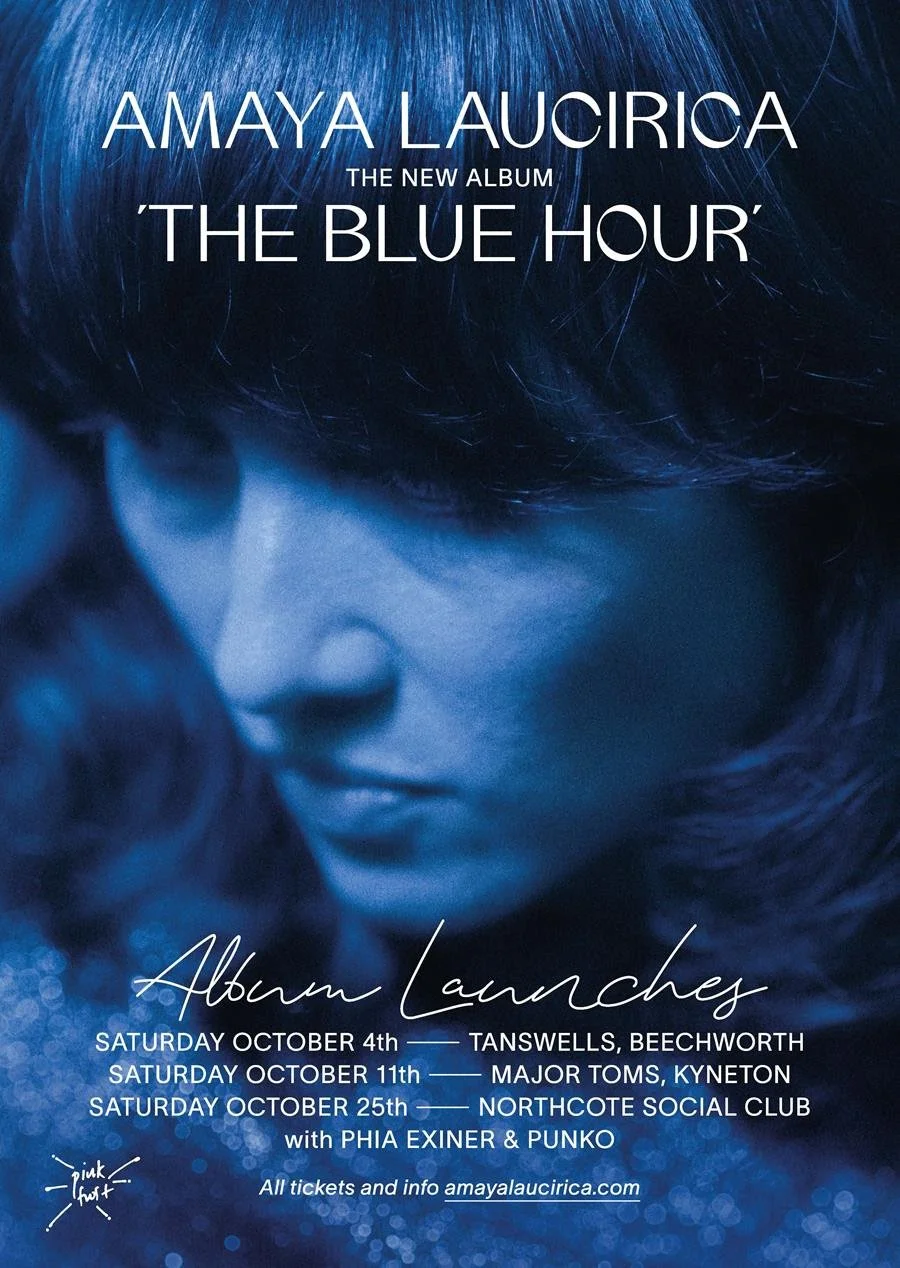
AMAYA LAUCIRICA – ALBUM LAUNCH TOUR (VIC)
Oct 4 – Tanswells, Beechworth, VIC
Oct 11 – Major Toms, Kyneton, VIC
Oct 25 – Northcote Social Club, Melbourne (with special guests Phia Exiner and Punko)